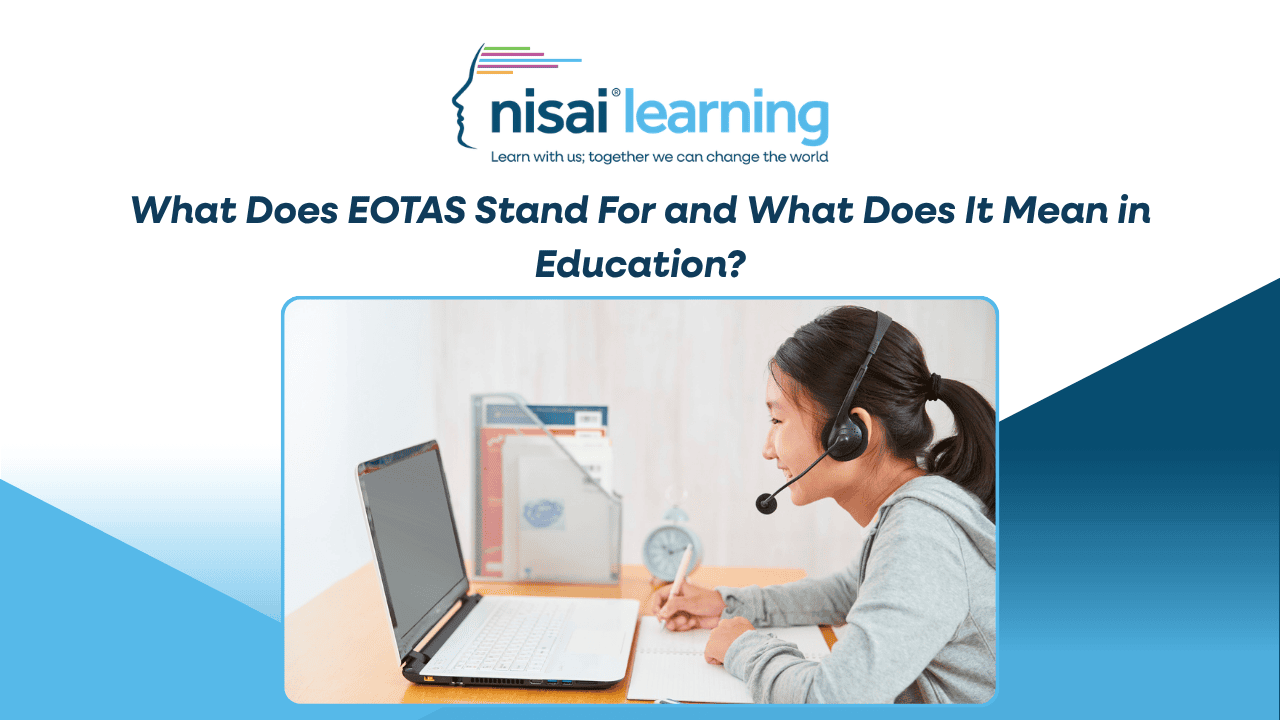
EOTAS stands for Education Otherwise Than At School. In England, it describes an arrangement where a local authority organises a child or young person’s special educational provision outside a school or college because education in a formal setting is not appropriate for their needs.
This does not mean the learner stops receiving education. Instead, their education is delivered differently and may take place at home, online, within the community or through a combination of suitable settings and services.
If you are looking for information about how Nisai can support an agreed arrangement, visit our dedicated EOTAS education and online learning page.
What Is EOTAS in Education?
When people ask “what is EOTAS in education?”, the simplest answer is that it provides a way for children and young people with special educational needs to receive suitable education outside a traditional school or college environment.
The Department for Education describes EOTAS as special educational provision arranged by a local authority somewhere other than a school or college because that setting is not right for the learner’s needs. It forms part of the learner’s Education, Health and Care arrangements.
The important point is that EOTAS is still structured education. A young person may continue to study academic subjects, receive teaching and feedback, work towards qualifications and develop practical or personal skills.
Why Is It Called Education Otherwise Than At School?
The name can sound more complicated than the idea behind it.
Education means the child or young person continues to receive learning and the special educational support they require.
Otherwise Than At School means that some or all of this provision takes place somewhere other than a conventional school or college.
For example, a learner could receive live online teaching at home alongside other agreed support. Another young person might have education delivered across several suitable environments.
The arrangement should reflect the individual’s needs rather than expecting every learner to fit the same school-based model.
What Changes When a Young Person Has EOTAS?
The biggest difference is usually where and how education is delivered.
Instead of attending a school building for their full programme, a learner may access education through different providers and services. Their timetable could combine academic teaching with additional specialist support.
This does not mean expectations around education disappear. The aim remains to provide learning that is appropriate to the child’s needs and supports meaningful future outcomes.
Young people receiving EOTAS may still:
-
- Follow an academic curriculum.
- Attend live lessons.
- Complete assignments and assessments.
- Work towards recognised qualifications.
- Receive specialist SEND support.
- Prepare for college, training or another future pathway.
You can explore the academic routes available through Nisai’s online curriculum.
What Does EOTAS Mean for an EHCP?
EOTAS in England is closely connected with the Education, Health and Care Plan process.
Where an EOTAS arrangement is agreed, the EHCP should clearly identify the special educational provision the child or young person requires and how that provision will be delivered.
The decision should be based on the learner’s individual circumstances and whether it would be inappropriate for their required provision to be made in a school or post-16 setting.
Families looking for more information about additional needs can read about Nisai’s SEND and EHCP support.
Who Is Responsible for Education Under EOTAS?
EOTAS is not a situation where parents are simply left to organise education themselves.
Where EOTAS is agreed, the local authority has responsibility for arranging the required provision. The learner, parents or carers should also be involved in decisions about what suitable education looks like.
This is one of the main reasons EOTAS should not be confused with elective home education.
Why Is EOTAS Different From Home Education?
Both EOTAS and elective home education can involve learning at home, which is why the terms are sometimes confused.
However, elective home education is a choice made by parents to take responsibility for their child’s education instead of sending them to school full-time.
EOTAS is different because the local authority arranges the special educational provision outside school or college.
Where the learning takes place does not, by itself, determine which arrangement a child has.
Is EOTAS the Same as Alternative Provision?
No. EOTAS and alternative provision are different, although both can involve education taking place outside mainstream school.
EOTAS concerns special educational provision delivered outside school or college because that setting is inappropriate for the learner’s needs.
Alternative provision may instead be arranged for children who cannot receive suitable education because of exclusion, illness or other circumstances. The Department for Education also distinguishes between these forms of provision.
Does EOTAS Mean a Child Can Never Return to School?
No. EOTAS does not automatically mean that education outside school will be permanent.
A learner’s circumstances and needs can change. For some young people, a future pathway might involve returning to mainstream education, moving into a special school, progressing to college or combining different forms of provision.
For others, EOTAS may remain the most suitable longer-term option.
The focus should remain on what helps the individual young person access education successfully rather than treating a return to school as the only positive outcome.
Where Can Online Education Fit Into EOTAS?
Online education can form one part of an EOTAS arrangement where it is suitable for the learner and included within the provision arranged for them.
Nisai provides live online education with teacher-led lessons, structured curriculum pathways and progress monitoring. This can allow young people to continue accessing academic education without needing to attend a traditional classroom.
Nisai is also accredited through the Department for Education’s Online Education Accreditation Scheme. You can learn more about the independent assessment of our provision and our OEAS Accreditation today.
Learn More About EOTAS With Nisai
Understanding what EOTAS stands for is an important first step, but every arrangement should be built around the individual child or young person.
For more information about how EOTAS works, the support an arrangement may include and how Nisai’s online education can form part of an agreed package, visit our EOTAS support page.